


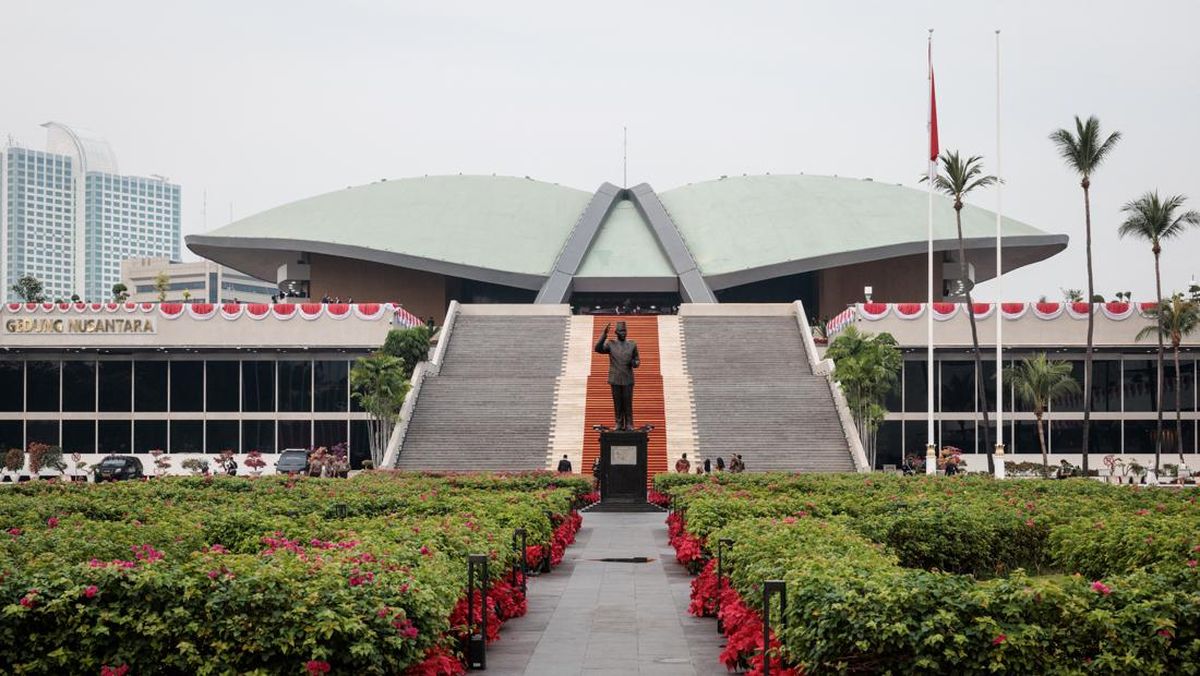
The Gedung Nusantara parliament complex in Jakarta. Photo: CNN
How a draft amendment to the 2014 Copyright Law could make Indonesia the first Southeast Asian country to put AI rules in its copyright statute.
A law written before the chatbots
Indonesia’s current Copyright Law dates from 2014, years before generative AI could write an essay, imitate an illustrator or compose a song on request. In March 2026 the House of Representatives approved a bill to amend it as a legislative initiative, which opened formal deliberations. The draft sits on the 2026 national legislative program, and if passed it would replace the existing law outright.
The core question is simple to state and hard to answer: when a machine helps make something, who owns it, and who pays when a machine learns from other people’s work?
Humans first
The draft keeps the human creator as the central subject of copyright. Works made with AI assistance can qualify for protection, but only where there is enough human creative involvement. Output that is fully AI-generated, with no human intellectual contribution, would receive none.
The bill does not say how much human involvement is enough, and that gap is likely to be the first thing courts and lawyers fight over. Earlier descriptions of the draft suggest a tiered test, so the threshold may be clarified in later revisions.
Two further rules aim at transparency and style. The draft would require disclosure when AI has been used in content, and it would prohibit using AI to copy an individual’s distinctive style. Even if the disclosure rule is hard to enforce, it signals that lawmakers want audiences to be able to tell what they are looking at.
Making platforms pay
The most contested part of the bill concerns news. Indonesian publishers say their journalism feeds AI tools and search products without a clear route to compensation, while their web traffic slumps. The draft responds by requiring technology platforms to compensate publishers when they aggregate, republish or show link previews of news, and when they use it to train AI.
Payments would flow through state-supervised collective management organisations, which would distribute the money to publishers. Tech companies have warned about overreach, innovation costs and compliance burdens. Publishers counter that the alternative is subsidising AI development with unpaid work.
The government is trying to hold both positions. In late July, the Communications and Digital Affairs Ministry said it was consulting platforms, publishers and creative industries, and that it wants the law to support AI development while giving rights holders legal certainty. The Ministry of Law continues to coordinate the bill.
Beyond AI: royalties and digital assets
The bill is broader than AI. It would create a government-managed Royalty Endowment Fund, intended to support creators’ welfare and social security, and would turn the National Collective Management Agency into a National Collective Management Commission running a transparent, integrated digital royalty system. Indonesia has long pushed for better royalty collection, including through proposals at WIPO.
It also addresses newer digital assets. For NFTs, the draft clarifies that buying a token proves authenticity but does not by itself transfer the copyright in the underlying work.
The enforcement problem
Writing rules is the easier half. The US Trade Representative has repeatedly identified enforcement as a weak point for Indonesia, and officials have acknowledged the need to tackle pirated digital content. Observers will be watching whether stronger protection on paper is matched by action against infringement in practice.
This sits alongside a wider modernisation of Indonesian IP: new patent and trademark application rules took effect in February 2026, online infringement complaints can now go to the Directorate General of Intellectual Property, and a revised fee schedule took effect in August.
What to watch
The latest reporting I could find is from late July 2026, and the bill was still being drafted and consulted on. Key questions remain open:
- How much human input will count as enough to earn protection?
- Will the final text keep the obligation for platforms to pay for news use and AI training?
- Can collective management bodies distribute money fairly and transparently?
- Will enforcement catch up with the new rules?
If Indonesia gets through these, its approach could become a reference point for neighbours facing the same pressures. If it stalls, the questions will not go away; they will just be answered by courts, contracts and the platforms themselves.
Sources
- SCMP, This Week in Asia: Indonesia’s AI copyright push opens new front in war over digital content
- Indonesia Business Post: AI forces Indonesia’s copyright reset
- MLex: Indonesia advances copyright amendment addressing AI-generated works (March 13, 2026)
- MLex: Indonesia consults digital platforms, media on AI copyright framework (July 29, 2026)
- MLex: Indonesia weighs AI training rules in copyright law overhaul (July 30, 2026)
- Rouse, via Mondaq: Indonesia Updates Copyright Law (June 24, 2026)
- Conventus Law: Indonesia Proposes Overhaul Of Copyright Law With Focus On Digital Content And Emerging Technologies (May 20, 2026)
- IIPLA News: Indonesia’s Draft Copyright Law Seeks to Regulate AI Content Creation and Platform Compensation (July 2026)
- SSEK Law Firm, via Conventus Law: Indonesia Introduces Updates To Patent, Trademark And Online IP Enforcement Regime (May 2026)
- Tilleke & Gibbins: Indonesia’s New IP Fee Schedule Signals Greater Focus on IP as Commercial Assets (July 24, 2026)